

Assess and Strengthen Your Data Foundation for Successful AI Adoption
The boardroom conversation is familiar: “We need to leverage AI to stay competitive.” This is followed by a recognition that the data foundation is weak, leading to heavy investments in platforms like Microsoft Fabric, building comprehensive data assets, and getting ready to implement cutting-edge AI capabilities. The promise is compelling: intelligent insights, automated decision-making, and unprecedented business agility, and once we move to this new data platform, all of our data issues will be fixed.
Yet months into these initiatives, the reality is often falling short. Teams spend weeks debating what metrics mean. AI models produce inconsistent results. And despite having more data than ever, organizations struggle to generate reliable insights that drive confident business decisions.
The culprit isn’t the technology, it’s the data foundation itself.
The Hidden Risk in Your AI Strategy
Impact Makers has worked with organizations embarking on data and AI transformations and we consistently see the same pattern: technical capabilities advance rapidly while data readiness lags behind. This creates a dangerous gap where sophisticated AI tools operate on fundamentally flawed data foundations.
Consider this: Over 80% of AI projects fail, twice the rate of failure for information technology projects that do not involve AI. Meanwhile, at least 30% of generative AI projects will be abandoned in 2025 after a proof of concept is completed because of poor data quality, inadequate risk controls, escalating costs, or unclear business value. Organizations that address these foundational challenges before scaling AI see dramatically different outcomes.
Over 80% of AI projects fail, twice the rate of failure for information technology projects that do not involve AI.
Early Warning Signs: Is Your Organization at Risk?
Through our client engagements, we’ve identified key indicators that predict AI initiative success or failure. Red flags we see frequently include:
- executive dashboards that show conflicting metrics from different departments;
- data teams spending 70%+ of their time on data clarification rather than analysis;
- AI pilots producing “interesting” results that can’t be acted upon with confidence;
- analytics projects consistently running 2-3x over timeline and budget; and
- different business units using the same terms to mean entirely different things.
63% of organizations either do not have or are unsure if they have the right data management practices for AI.
Research also consistently shows that data quality is the primary culprit behind AI failure. Seventy percent of AI projects fail to meet their goals due to issues with data quality and integration. Meanwhile, 63% of organizations either do not have or are unsure if they have the right data management practices for AI.
The Data Readiness Assessment: Know Where You Stand
Impact Makers developed a framework that helps organizations quickly identify their biggest data readiness gaps. Here’s a simplified version you can use to evaluate your current state.
The Five Minute Executive Assessment
- Semantic Alignment Test: Ask three department heads to define your most critical business metric (e.g., “customer satisfaction,” “revenue growth,” “operational efficiency”). If you get significantly different answers, you have a semantic clarity problem that will undermine any AI initiative.
- Data Confidence Test: Can your executives confidently explain to the board exactly how your top KPIs are calculated and why they should trust those numbers? If there’s hesitation or uncertainty, your data foundation needs strengthening.
- AI Readiness Test: When you implement AI tools, do they produce insights that align with business intuition and can be validated by domain experts? If AI outputs often seem “off” or require extensive verification, your data isn’t properly contextualizing the models.
The Detailed Organizational Assessment
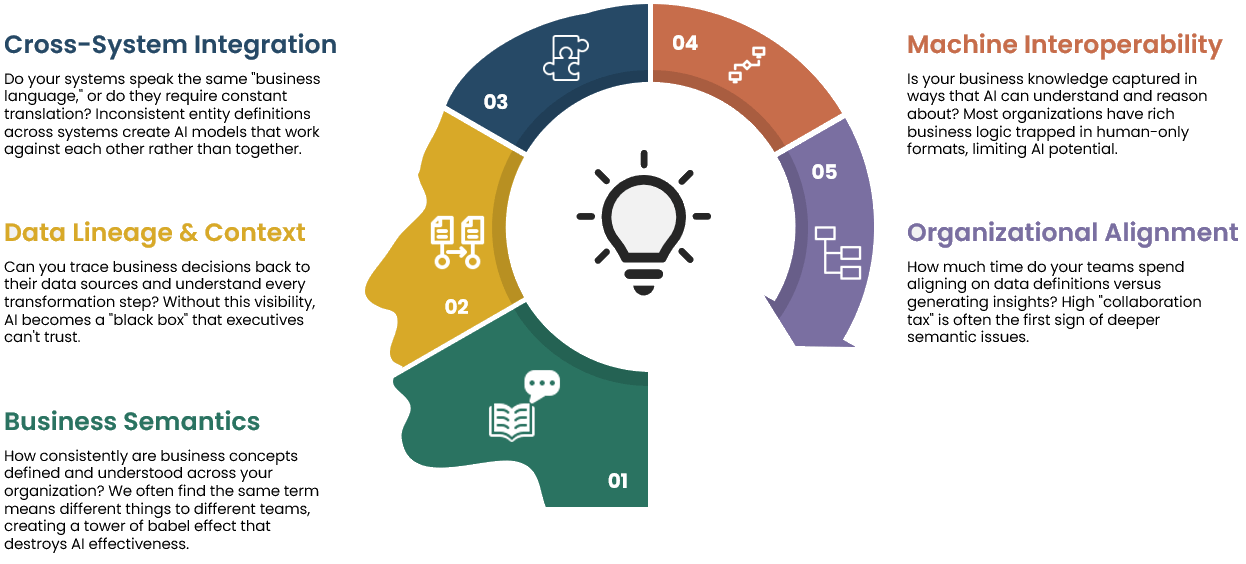
For a comprehensive evaluation, our assessment examines five critical dimensions:
The Path Forward: Building AI-Ready Data Foundations
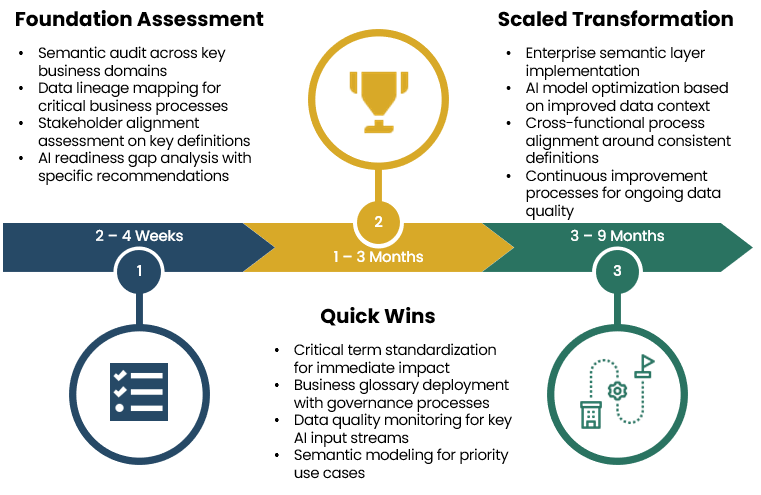
Based on our experience helping organizations transform their data foundations, here’s how successful companies approach the challenge:
Why This Approach Delivers Results
Organizations that invest in semantic foundations before scaling AI consistently achieve:
- faster analytics project delivery and reduced development timelines;
- significantly improved AI model accuracy and business relevance;
- higher confidence in data-driven decision making at all levels;
- better ROI on existing data infrastructure investments; and
- reduced collaboration overhead with clearer data definitions.
Recent research shows that companies implementing proper AI adoption practices see measurable improvements. According to McKinsey’s 2025 AI survey, organizations reporting “significant” financial returns are twice as likely to have redesigned end-to-end workflows before selecting modeling techniques.
Recent research shows that companies implementing proper AI adoption practices see measurable improvements.
Leveraging Your Current Investments
This approach amplifies rather than replaces your current technology investments in the following ways:
- Microsoft Fabric environments become exponentially more valuable with proper semantic foundations
- Existing AI models perform better with contextually rich, consistent data inputs
- Analytics teams spend time generating insights rather than debating definitions
- Business users gain confidence in automated insights and recommendations
Your Strategic Options
Option 1: Continue Current Path
Hope that technical solutions will overcome data foundation issues. Risk: Continued AI initiative underperformance and growing organizational frustration.
Option 2: DIY Approach
Build internal capabilities to address semantic and data quality challenges. Timeline: 12-24 months with uncertain outcomes and high opportunity cost.
Option 3: Accelerated Transformation
Partner with experts who have solved these challenges repeatedly across multiple industries. Timeline: 3-6 months to meaningful improvement with proven methodologies.
Taking Action
The AI revolution rewards organizations that make their data perfectly clear. While competitors struggle with data interpretation and AI reliability, you can build a sustainable competitive advantage through superior data foundations.
Immediate Next Steps
- Conduct the 5-minute assessment with your leadership team.
- Inventory your current AI initiatives and their data dependencies.
- Identify your highest impact use case for semantic foundation improvements.
- Evaluate your options for addressing foundational challenges.
The technology to transform your data foundation exists today. The question isn’t whether to address these challenges, it’s how quickly you can gain the competitive advantage that comes with AI built on rock-solid data foundations.
Ready to turn your data from a liability into a strategic weapon?
Our data and AI practice has helped organizations across industries achieve AI success through proven semantic foundation methodologies. Let’s discuss how this approach can accelerate your AI initiatives and deliver measurable business impact.
Contact us to schedule a complimentary data readiness assessment and explore how we can help you build the foundation for AI success.
Read the Entire AI Adoption Series for State Agencies
For more practical insights, proven examples, and actionable strategies tailored for state agency leaders, check out the rest of our AI Adoption series below.
- Unlocking AI: A Critical Moment for State Agencies: Real World Value for State Agencies
- Developing you Agency’s AI Roadmap: Identify where AI can deliver the greatest value in your agency.
- Experimentation and the Role of an Innovation Sandbox: Learn how to safely pilot and scale AI solutions.
- Change Management, Training, and Re-Skilling: Prepare your workforce for the future of AI-powered government.
References
- RAND Corporation. “The Root Causes of Failure for Artificial Intelligence Projects and How They Can Succeed“
- Fortune. “MIT report: 95% of generative AI pilots at companies are failing“
- Project Management institute. “Why Most AI Projects Fail: 10 Mistakes to Avoid“
- Gartner. “Lack of AI-Ready Data Puts AI Projects at Risk“
- Gartner. “Gartner Predicts 30% of Generative AI Projects Will Be Abandoned After Proof of Concept By End of 2025“
- Harvard Business Review. “Keep Your AI Projects on Track“